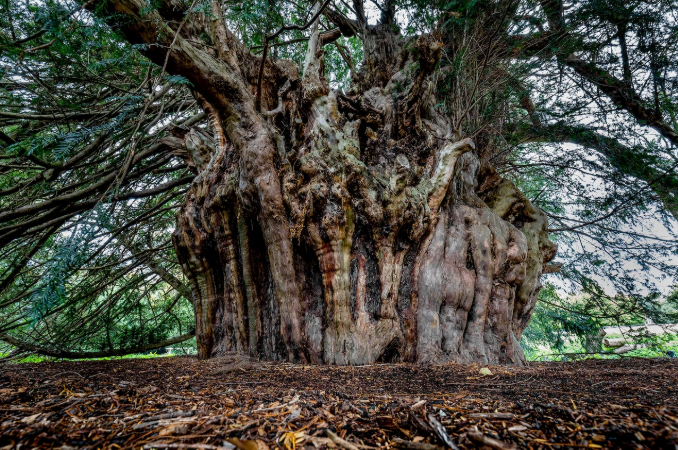
Photograph by Steve Taylor, Alamy (https://www.nationalgeographic.com/travel/article/uk-historic-oldest-trees-stories)
Heritage trees are far more than just ancient landmarks; they are the biological anchors of our environment. As these majestic giants age, their ability to provide critical ecosystem services scales exponentially. Unlike younger saplings, a single ancient tree can support hundreds of species, acting as a “vertical city” for biodiversity. Their complex structures—hollow trunks, craggy bark, and massive canopies—offer unique niches for rare epiphytes, specialized insects, and nesting birds that cannot survive in younger forests.
Carbon Sequestration and Climate Stability
From a climate perspective, heritage trees are irreplaceable carbon vaults. While young trees grow quickly, old-growth giants store the vast majority of forest biomass. Through decades of photosynthesis, they lock away metric tons of carbon dioxide, keeping it out of our atmosphere. Their deep root systems also stabilize the soil and manage local microclimates, significantly cooling the surrounding air through transpiration—a natural air conditioning effect that is vital in the face of rising global temperatures.
Hydrological Guardians
The hydrological benefits of heritage trees are equally impressive. Their expansive root networks act like massive sponges, absorbing rainwater and filtering pollutants before they reach our groundwater. By slowing down runoff, these trees prevent soil erosion and mitigate the risk of flash flooding. In urban settings, a single heritage tree can intercept thousands of liters of rainfall annually, reducing the strain on man-made drainage systems and protecting the local watershed.
Cultural and Psychological Foundations
Beyond the physical, heritage trees bridge the gap between nature and human history. They serve as living witnesses to centuries of change, holding immense cultural, spiritual, and aesthetic value for communities. Research in environmental psychology consistently shows that proximity to these ancient beings reduces stress, lowers blood pressure, and fosters a sense of continuity and belonging. They are not just biological assets; they are the soul of the landscape.
References
- Lindenmayer, D. B., & Laurance, W. F. (2017). The ecology, distribution, conservation and management of large old trees. Biological Reviews.
- Stephenson, N. L., et al. (2014). Rate of tree carbon accumulation increases continuously with tree size. Nature.
- Blicharska, M., & Mikusiński, G. (2014). Incorporating social and cultural significance of large old trees into conservation policy. Conservation Biology.